
Meteors frequently burn up in our atmosphere - usually too quickly and too high to ever be seen. Many of these come when a comet or other source of debris in space passes near the Earth - a lot of these events recur often.
One of the common methods to reliably detect these meteor events is essentially to shine a torch on them. Given that we have a lot of visible light around and the meteors are quite small, the best choice for the "torch" is usually radio frequency, which doesn't reflect off the meteor but will reflect off the trail of ionized air it leaves in it's path.
In addition to the "torch" (a radio source), we also need an eye to see it with (an aerial). As radio frequencies tend to pass through things and the items we're reflecting the signal off are quite small, the best choice for a transmitter is one that is both quite powerful but also blocked from view by the curve of the planet, so that the only signals we pick up from it are reflections from high in the atmosphere (ie meteors).
To that end, the transmitter we make use of is one that has been set up for this purpose in Dijon - Broadcasting a constant tone at 143.03 MHz (A little above the usual FM Radio frequencies)
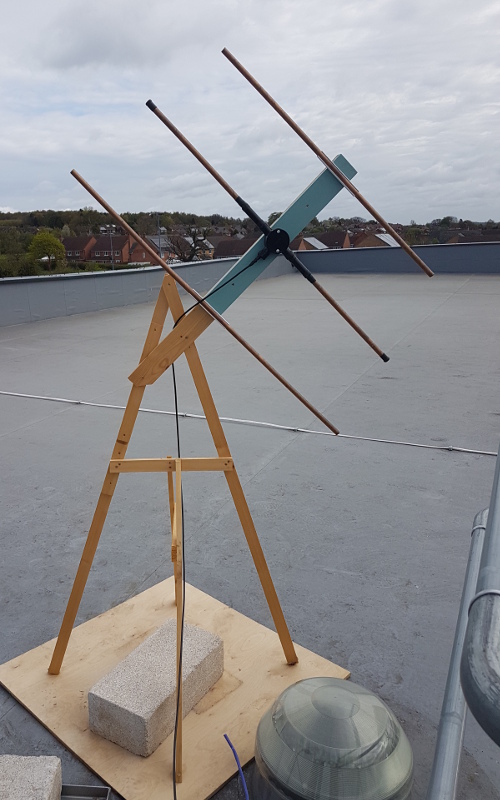
The aerial is one we've built to match the transmission frequency (pictured right), which is pointed towards the sky in the direction of Dijon.
We then use a piece of software call Spectrum Lab to process and monitor the radio signal. The basic configuration is a pre-built one provided for this purpose; we've made minor adjustments to the gain and out put settings for our site.
The software is tuned to a frequency just below the target frequency (143.028 MHz), as it can scan across a range of adjacent bands - this is important for two reasons. First, the receiver may not be perfectly tuned, so being able to pick up over a range helps adjust for inaccuracies in the receiver, but secondly - due to the speed of high altitude winds, we will see some doppler shift in the received data.
Spectrum Lab will measure the incoming data, mark down and take a screenshot of any spikes in the signal (caused by the trails of ionized air Meteors leave behind them), and also logs that same data into spreadsheet for later analysis.
Some interesting details about the incoming signals:
- The signal is not from the Meteor, it's from the air the Meteor passes through - as such any Doppler shift is from wind speed, not the Meteor speed
- Smaller meteors that aren't visible to the naked eye tend to Show a brief, strong signal which fades out quickly.
- Meteors that a large enough to be seen unaided tend to have longer trails.
- These trails will have a fairly consistent signal strength
- However, due to the speed and buffeting of the high altitude winds, the received signal may appear spotty, with some doppler shifting as the wind changes
- Occasionally, for brighter Meteors, the cloud of plasma around the Meteor will be significant enough for the signal to reflect off that - which will cause a signal with a strong and changing doppler effect caused by the actual speed of the Meteor.
- More information available from The International Meteor Organization